HTTPS
The Hypertext Transfer Protocol Secure (HTTPS) is a secure network protocol that extends HTTP by adding Secure Sockets Layer (SSL)/TLS (Transport Layer Security) encryption. It is widely used for secure web-based file exchanges due to its strong encryption and browser support. HTTPS encrypts all communication between the client and server, including authentication credentials and file data.
It provides confidentiality, integrity, and authentication by encrypting data in transit and verifying the identity of connected parties.
UDMG HTTPS Implementation
UDMG uses HTTPS to provide the Web Transfer Client (WTC), a browser-based interface for secure file transfers. UDMG acts as the HTTPS Server, allowing partners to connect using any modern web browser without specialized client software. The HTTPS listener is configured globally via the wtc block in the UDMG Configuration File. Domain-specific behaviors such as branding, authentication settings, and Pipeline routing are managed through the UDMG Admin UI. This architecture enables UDMG to serve multiple partners under a single HTTPS listener with customized experiences per Domain.
UDMG as HTTPS Server
This configuration uses a Local HTTPS Server to Local Filesystem Pipeline.
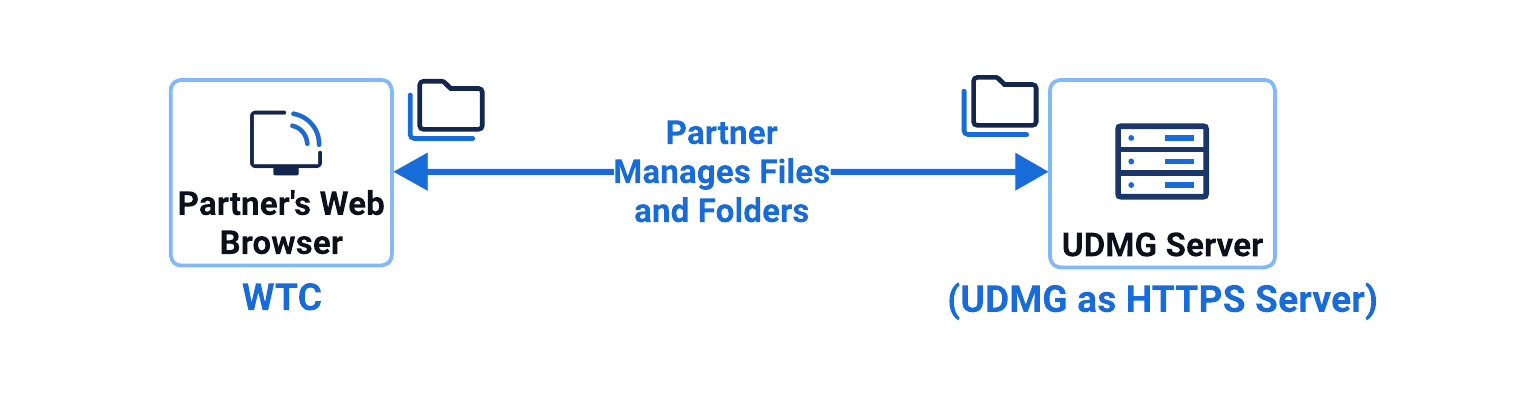
In this configuration:
- UDMG hosts a Local HTTPS Server (WTC) Endpoint that exposes the WTC interface.
- Partners connect to the WTC, typically using a URL such as:
https://<fqdn>:<port>/workspace/<domain>
- The WTC authenticates partner Accounts using credentials based on their login method.
- After authentication, partners can browse, upload, download, share, and manage files within the directories defined in the assigned Pipelines.
- The HTTPS listener handles all TLS encryption, ensuring secure communication between the partner's browser and the UDMG Server.