Manual Trigger
The Manual trigger allows you to launch a task immediately, while setting or overriding the value of one or more user-defined variables specified in the task.
Use a Manual trigger if you want to manually launch a task but cannot use the Launch Task or Trigger Now buttons because you have to set or override one or more variables. For example, you might choose to use a Manual trigger to launch a "generic" Workflow that you run occasionally with a slight variation in specific details. In this case, you will launch the Workflow and pass in the appropriate details using variables.
You can use the Manual trigger to set values to pre-existing variables or create new variables. The variable values you enter here override all others. However, the change in value only persists while this launched task instance(s) is running. Future executions of the task(s), unless they are launched by a Manual trigger, will use the standard methods for resolving user-defined variables.
The audit message created when you use a Manual trigger is the same as Trigger Now.
Creating a Manual Trigger and Triggering One or More Tasks
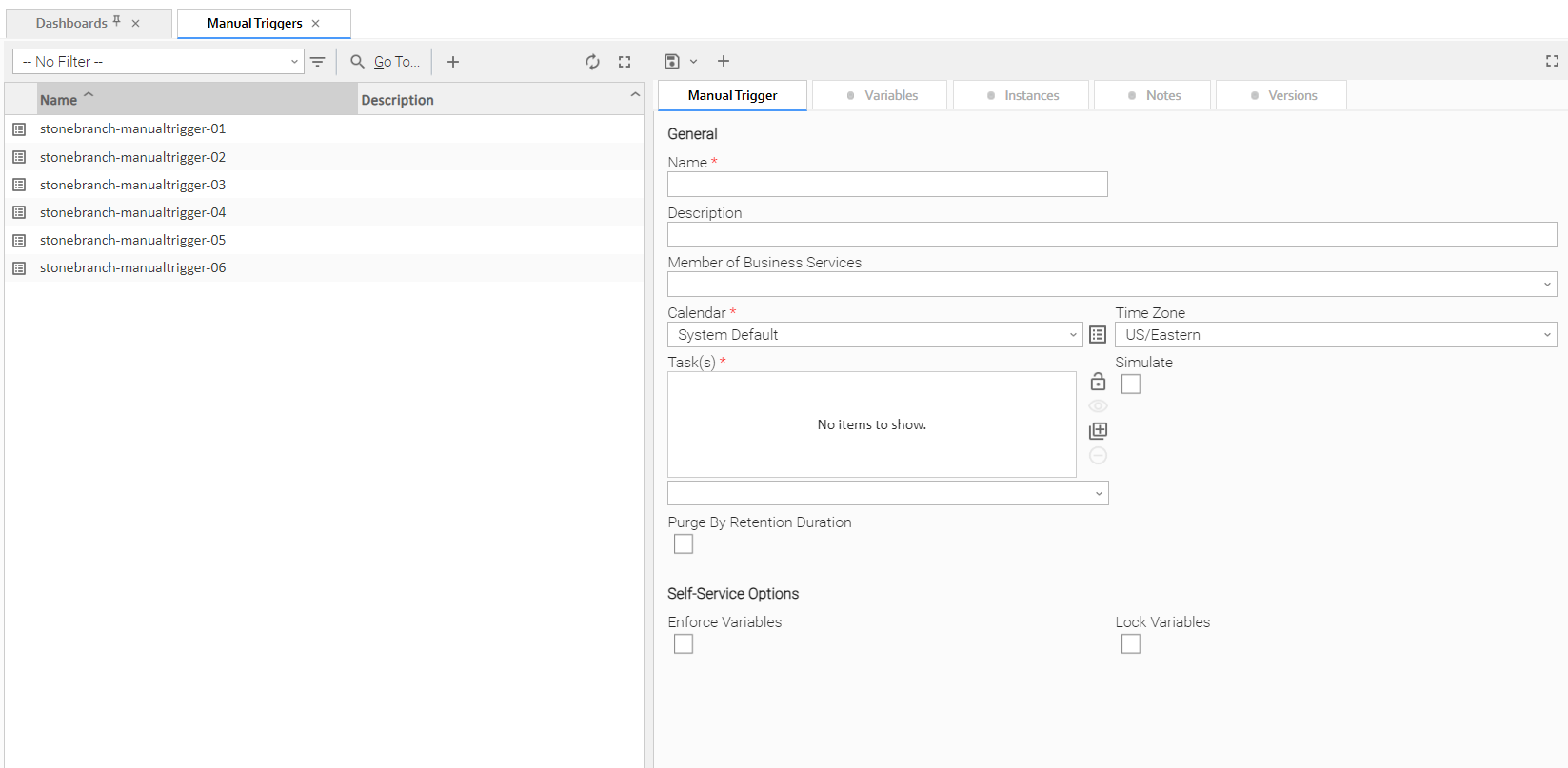
Step 1 | From the Automation Center navigation pane, select Triggers > Manual Triggers. The Manual Triggers list displays. To the right of the list, Manual Trigger Details for a new Manual trigger displays.
|
|---|---|
Step 2 | Enter/select Details for a new Manual trigger, using the field descriptions below as a guide.
To display more of the Details fields on the screen, you can either:
|
Step 3 | Click a |
Step 4 | Enable the trigger(s) as desired. |
 button above the list to display a pop-up version of the Details.
 button. The trigger is added to the database, and all buttons and tabs in the Trigger Details are enabled.
To open an existing record on the list, either:
- Click a record in the list to display its record Details below the list. (To clear record Details below the list, click the New button that displays above and below the Details.)
- Clicking the Details icon next to a record name in the list, or right-click a record in the list and then click Open in the Action menu that displays, to display a pop-up version of the record Details.
- Right-click a record in the a list, or open a record and right-click in the record Details, and then click Open In Tab in the Action menu that displays, to display the record Details under a new tab on the record list page (see Record Details as Tabs).
Manual Trigger Details
The following Manual Trigger Details is for an existing Manual trigger. See the field descriptions, below, for a description of the fields that display in the Manual Trigger Details.
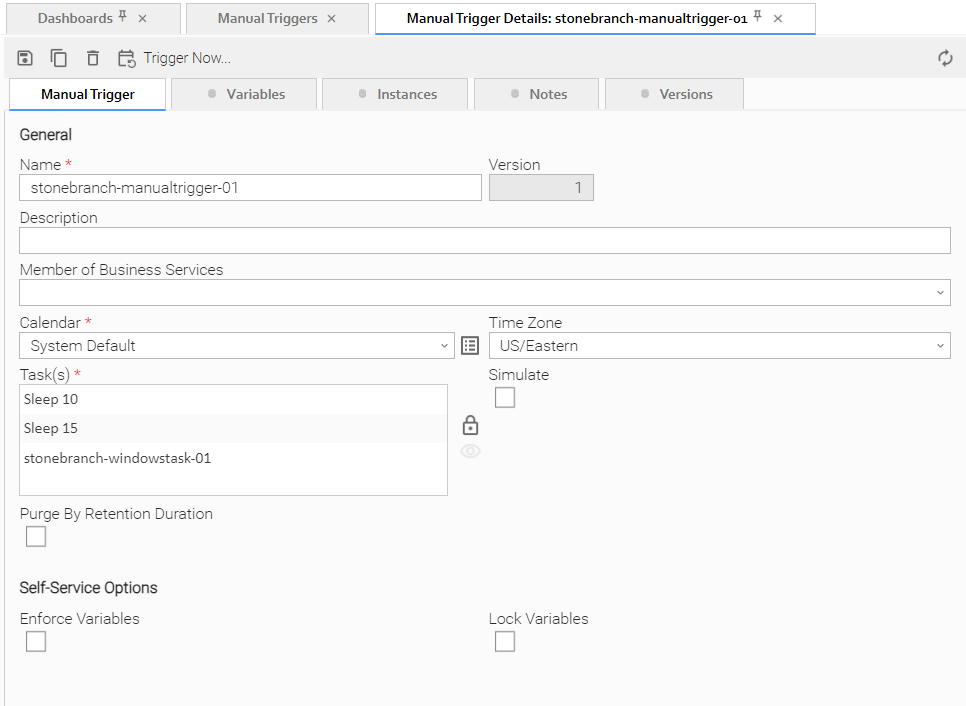
Manual Trigger Details Field Descriptions
The following tables describe the fields, buttons, and tabs that display in the Manual Trigger Details.
General
This section contains general information about the trigger.
Field Name | Description |
|---|---|
Name | Name used within the Controller to identify this trigger. It can contain a maximum of 255 alphanumerics. It is the responsibility of the user to develop a workable naming scheme for triggers. |
Version | System-supplied; version number of the current record, which is incremented by the system every time a user updates a record. Click the Versions tab to view previous versions. For details, see Record Versioning. |
Description | Description of this record. Maximum length is 255 characters. |
Member of Business Services | User-defined; Allows you to select one or more Business Services that this record belongs to. (You also can Check All or Uncheck All Business Services for this record.) You can select up to 62 Business Services for any record type, and enter a maximum of 2048 characters for each Business Service. If the Business Service Visibility Restricted Universal Controller system property is set to true, depending on your assigned (or inherited) Permissions or Roles, Business Services available for selection may be restricted. |
Calendar | Calendar that defines the business days, holidays, and other special days that determine the run dates for the task(s) specified in the trigger. Select a Calendar from the drop-down list of all existing Calendars. To display detailed information about a selected calendar, click the Details icon next to the Calendar field. |
Time Zone | User-defined; allows you to specify the time zone that will be applied to the time(s) specified in the trigger. For example, if you specify 23:00 and a time zone of Canada/Central, the task will run at 11:00 p.m. Central Canada time. |
Task(s) | Name of the task(s) being triggered when this trigger is satisfied. When selecting tasks from the Details, click on the lock icon to unlock the field and select tasks. |
Simulate | Specifies if the instances generated by this trigger should execute under simulation mode, in which none of the tasks execute. Alternatively, simulation mode can be enabled from the Trigger Now… command (see Triggering with Variables and Triggering by Date and Time). |
Purge By Retention Duration | Specification for whether triggered task instances can be purged by retention duration. |
Exclude Backup | If Purge By Retention Duration is selected; Specification for whether qualifying task instances can be excluded from the backup when being purged by retention duration. |
Retention Duration | If Purge By Retention Duration is selected; Minimum retention duration for the selected Retention Duration Unit before triggered task instances can qualify for purge. If Retention Duration Unit = Days, valid values are 1 to 366. If Retention Duration Unit = Hours, valid values are 1 to 24. |
Retention Duration Unit | If Purge By Retention Duration is selected; Retention duration unit. Options:
|
Execution User | Read-only; Execution user that has been selected (via the Assign Execution User action) to override the execution user of task instances being launched by the trigger. |
Self-Service Options
This section contains Self-Service specifications for the trigger.
Field Name | Description |
|---|---|
Enforce Variables | Specifies whether or not to enforce Override Trigger Variables when using Trigger Now... from the User Interface. |
Lock Variables | Specifies whether or not to prevent editing variables when using Trigger Now... from the User Interface. |
Metadata
This section contains Metadata information about this record.
Field Name | Description |
|---|---|
UUID | Universally Unique Identifier of this record. |
Updated By | Name of the user that last updated this record. |
Updated | Date and time that this record was last updated. |
Created By | Name of the user that created this record. |
Created | Date and time that this record was created. |
Buttons
This section identifies the buttons displayed above and below the Trigger Details that let you perform various actions.
Field Name | Description |
|---|---|
Save | Saves a new task record in the Controller database. |
Save & New | Saves a new record in the Controller database and redisplays empty Details so that you can create another new record. |
Save & View | Saves a new record in the Controller database and continues to display that record. |
New | Displays empty (except for default values) Details for creating a new record. |
Update | Saves updates to the record. |
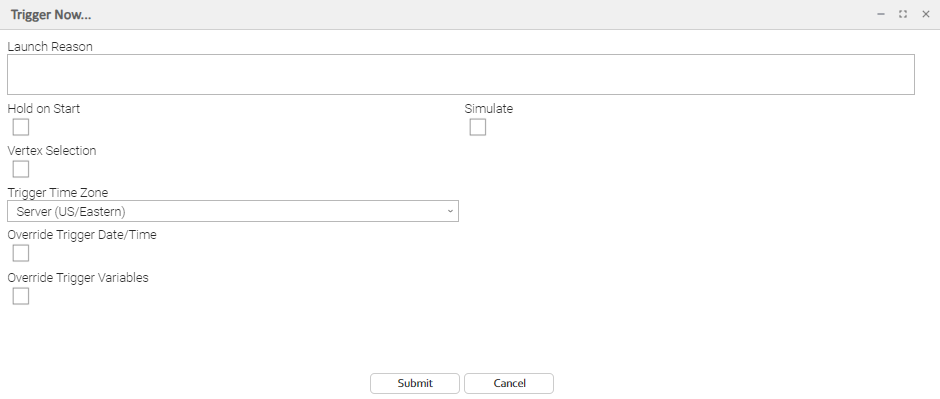
Trigger Now | Opens a Trigger Now... dialog to immediately trigger all tasks specified in this trigger.
info If you click Trigger Now... for an Enabled trigger that does not have an assigned Execution User, the trigger will launch its task(s) under the context of the Enabled By user. If you click Trigger Now... for a Disabled trigger that does not have an assigned Execution User, the trigger will launch its task(s) under the context of your user name and ID. If you click Trigger Now... for an Enabled or Disabled trigger that has an assigned Execution User, the trigger will launch its task(s) under the context of the assigned Execution User. |
Copy | Creates a copy of this trigger, which you are prompted to rename. |
Delete | Deletes the current record. |
Refresh | Refreshes any dynamic data displayed in the Details. |
Close | For pop-up view only; closes the pop-up view of this trigger. |
Tabs
This section identifies the tabs across the top of the Trigger Details that provide access to additional information about the trigger.
Field Name | Description |
|---|---|
Variables | Lists all user-defined variables associated with this record; that is, variables that have been defined for this specific record. |
Instances | Lists all task instances that were triggered directly by this trigger. |
Notes | Lists all notes associated with this record. |
Versions | Stores copies of all previous versions of the current record. See Record Versioning. |
Entering Variables
Two methods are available for entering variables:
- Use the Trigger With Variables Action menu item.
- Use the Variables tab and Trigger Now button.
If you want to preserve information about the variables you are setting or overriding (the name and value), or if you want to specify default values, use the Variables tab. If you set up a Manual trigger with default values in the Variables tab, any values you set using the Trigger With Variables popup window override the values in the Variables tab. Each method is described below.
Using the Trigger with Variables Menu Option
Step 1 | Select a trigger from the Manual Triggers list. |
|---|---|
Step 2 | Access the Action menu. |
Step 2 | Select Trigger Now With Variables. A Trigger Now pop-up window displays that lets you set or override the values of up to 10 variables that will be used in the execution of the task(s) named in the Manual trigger. These can be existing or new variables. Any existing variables are automatically populated in the window. |
Step 3 | Click Submit to launch the tasks named in the trigger. The variable information in the Trigger Now pop-up is passed into the task instance(s) where referenced and the contents of the pop-up are deleted. |
Using the Variables Tab
Step 1 | Click the Variables tab. |
|---|---|
Step 2 | Use the New button to add the variables you want to set. |
Step 3 | When you are finished, click the Manual Trigger tab and then click the Trigger Now button to launch the tasks named in the trigger. |